**Léon Spilliaert**
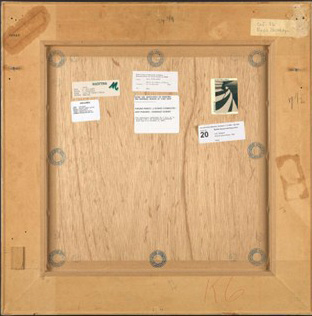
*Salle de tables d'hôtes*, dos du cadre
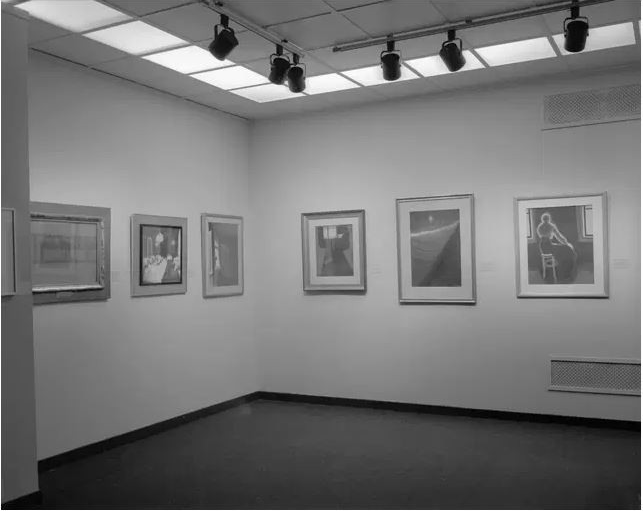
MRBAB, inv. 6873 Bien que *Salle de tables d'hôtes*, à notre connaissance, soit toujours restée dans des collections belges, l'œuvre a sillonné le monde. Depuis sa création en 1904, ce dessin a en effet été présenté lors de 32 expositions dans 38 lieux différents, ce qui témoigne de la pertinence et de l'attrait durables de l'œuvre de Spilliaert. Avant même que le dessin n'intègre la collection des Musées royaux des Beaux-Arts de Belgique, il avait déjà voyagé à l'étranger, comme par exemple à Nuremberg en 1955, pour l'exposition *50 Jahre belgische Kunst*, qui portait sur l'art belge de la période 1890-1940. Fait notable, dans le catalogue de l'exposition, il était décrit comme une peinture sur toile. Cependant, une étiquette au dos de l'œuvre et la description dans le catalogue confirment qu'il s'agit bien du dessin que nous connaissons aujourd'hui, qui, comme la quasi-totalité des œuvres de Spilliaert, a été réalisé sur papier. Peu après l'entrée de *Salle de tables d'hôtes* dans la collection des MRFAB, l'œuvre a été incluse en 1961 dans l'exposition *Œuvres d'art acquises par l'État. Prix et distinctions octroyés à des artistes belges*. Au cours des décennies suivantes, l'œuvre a entrepris un voyage international, de l'exposition *Europa 1900* à Ostende en 1967 à *Belgian Art 1880-1914* au Brooklyn Museum de New York en 1980. Temps fort dans la vie de l'œuvre, elle a aussi figuré dans la grande exposition *Léon Spilliaert 1881-1946*, présentée en 1981-1982 dans notre propre musée, puis aux Galeries Nationales du Grand Palais à Paris et au Kröller-Müller Museum à Otterlo (Pays-Bas).
Belgian Art, 1880-1914
Vue de l'exposition, Brooklyn Museum, New-York
(24/04/1980 - 29/06/1980)
L'organisation de tels prêts pour des expositions s'accompagne de **défis complexes en termes de logistique et de conservation**. Chaque transport est méticuleusement préparé, souvent dans des camions climatisés (afin de minimiser les fluctuations de température et d'humidité) et équipés de suspension pneumatique pour limiter les vibrations. Avant le voyage, l'état de l'œuvre est documenté avec précision. Les **conditions d'exposition**, et en particulier le climat, sont également étroitement contrôlées. Pour les œuvres sur papier en particulier, l'exposition à la lumière est un facteur crucial, car les dommages causés par la lumière sont cumulatifs et irréversibles. La quantité de lumière que reçoit le dessin, mesurée en lux, est donc strictement limitée. Toutes ces mesures sont prises pour garantir la sécurité des œuvres d'art lors de leur transport et exposition.
*Crédits photos : © MRBAB, Bruxelles / photo : J. Geleyns - Art Photography | © Records of the Department of Photography, The Brooklyn Museum Archives*
*Salle de tables d'hôtes*, dos du cadre
MRBAB, inv. 6873 Bien que *Salle de tables d'hôtes*, à notre connaissance, soit toujours restée dans des collections belges, l'œuvre a sillonné le monde. Depuis sa création en 1904, ce dessin a en effet été présenté lors de 32 expositions dans 38 lieux différents, ce qui témoigne de la pertinence et de l'attrait durables de l'œuvre de Spilliaert. Avant même que le dessin n'intègre la collection des Musées royaux des Beaux-Arts de Belgique, il avait déjà voyagé à l'étranger, comme par exemple à Nuremberg en 1955, pour l'exposition *50 Jahre belgische Kunst*, qui portait sur l'art belge de la période 1890-1940. Fait notable, dans le catalogue de l'exposition, il était décrit comme une peinture sur toile. Cependant, une étiquette au dos de l'œuvre et la description dans le catalogue confirment qu'il s'agit bien du dessin que nous connaissons aujourd'hui, qui, comme la quasi-totalité des œuvres de Spilliaert, a été réalisé sur papier. Peu après l'entrée de *Salle de tables d'hôtes* dans la collection des MRFAB, l'œuvre a été incluse en 1961 dans l'exposition *Œuvres d'art acquises par l'État. Prix et distinctions octroyés à des artistes belges*. Au cours des décennies suivantes, l'œuvre a entrepris un voyage international, de l'exposition *Europa 1900* à Ostende en 1967 à *Belgian Art 1880-1914* au Brooklyn Museum de New York en 1980. Temps fort dans la vie de l'œuvre, elle a aussi figuré dans la grande exposition *Léon Spilliaert 1881-1946*, présentée en 1981-1982 dans notre propre musée, puis aux Galeries Nationales du Grand Palais à Paris et au Kröller-Müller Museum à Otterlo (Pays-Bas).
Vue de l'exposition, Brooklyn Museum, New-York
(24/04/1980 - 29/06/1980)
Design et développement web Marie-Noëlle Grison & Robert G. Erdmann