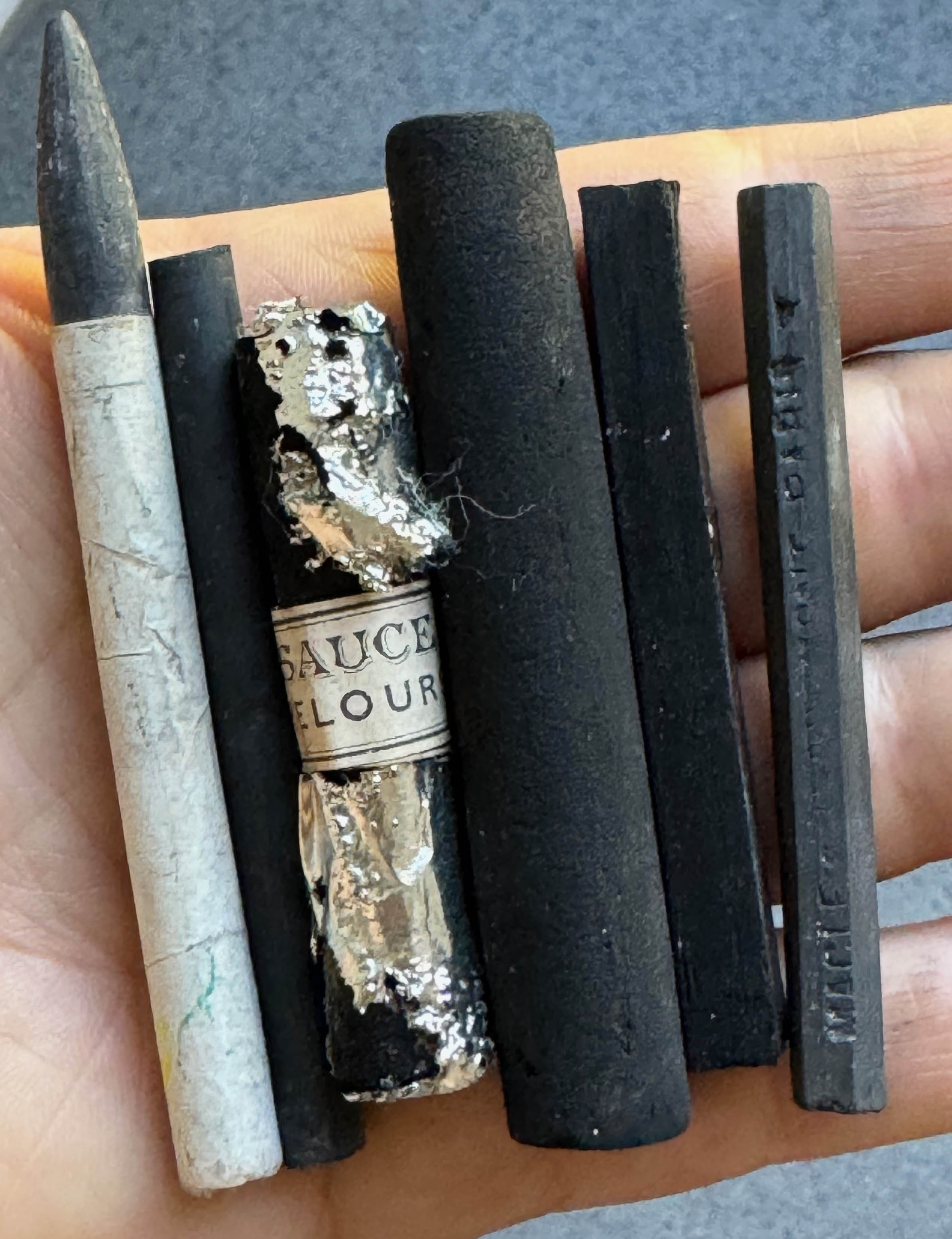
### Outils et techniques
Les matériaux friables, tels que le pastel, le fusain et la craie, offrent aux artistes une vaste gamme de possibilités expressives. Choix des matériaux, manipulation et combinaisons de techniques : tous ces éléments déterminent l'apparence finale de l'œuvre.
Chacune de ces trois techniques de dessin possède ses propres caractéristiques. Le **pastel**, utilisé depuis le 16e siècle, connaît un renouveau au 18e puis à la fin du 19e siècle. Il est fabriqué à partir de pigments auxquels on ajoute une charge blanche et une faible quantité de liant. On obtient ainsi une matière tendre mais consistante, modelée en bâtonnets de différentes formes et duretés, appliqués directement ou sous forme de poudre.
Le **fusain**, dont l'usage remonte à l'Antiquité, est produit à partir de rameaux de saule ou de vigne, chauffés à haute température dans un récipient clos et privé d'oxygène. Ce procédé produit un bâtonnet rigide, permettant de tracer des lignes noires de diverses épaisseurs selon la manière dont il est tenu. Il peut également être appliqué sous forme de poudre, directement sur le papier.
La **craie** est un matériau naturel et d'emploi facile. Elle peut être sciée en formes spécifiques, ce qui la rend apte à tracer des lignes fines et détaillées. À l'état naturel, elle existe en blanc, en noir et en différentes nuances de rouge, ce dernier ton étant souvent désigné sous le nom de « sanguine ». Lorsque ces trois couleurs de craie sont utilisées conjointement dans une même composition, on parle de dessin « aux trois crayons ». Au 19e siècle, la plupart des craies disponibles dans le commerce sont issues d'une fabrication artificielle et ne proviennent plus directement de carrières naturelles.
La texture poudreuse et granuleuse de ces matériaux est au cœur du processus artistique. L'artiste peut manipuler les traits ou les aplats en les travaillant avec le doigt ou à l'aide d'**outils** tels que l'estompe. Le dessin peut également être retravaillé par grattage, par enlèvement de matière, avec des rehauts de couleurs claires, par mélange des techniques ou encore par gommage de certaines parties.
Afin de préserver l'œuvre et d'éviter que ces matériaux friables ne se détachent de leur support, on peut appliquer un **fixatif**. Celui-ci peut servir de couche protectrice finale ou être utilisé entre plusieurs applications de médium pour faciliter l'élaboration du dessin. Si aujourd'hui les fixatifs se présentent le plus souvent sous forme d'aérosols, ils ont existé, au fil du temps, sous de nombreuses autres formes.
*Photo : Margaret Zayer*
### Materialen en technieken
Poederige materialen, zoals pastel, houtskool en krijt, bieden kunstenaars een breed scala aan expressieve mogelijkheden. De keuze, bewerking en combinatie van deze materialen zijn bepalend voor het uiteindelijke resultaat van het kunstwerk.
De drie voornaamste poederige tekenmaterialen hebben elk hun eigen kenmerken. **Pastel** wordt al sinds de 16e gebruikt en kende een heropleving in de 18e en laat 19e eeuw. Het wordt gemaakt door pigmenten te mengen met een wit vulmiddel en een kleine hoeveelheid bindmiddel. Het levert een zacht, maar toch stevig tekenmateriaal op dat in diverse vormen beschikbaar is, van poeder tot pastelkrijt en -potlood.
**Houtskool**, een materiaal met een geschiedenis die teruggaat tot de oudheid, wordt gemaakt van twijgen van wilgen of wijnstokken, die in een afgesloten vat zonder zuurstof op hoge temperatuur worden verhit. Dit resulteert in een stevig tekenstokje waarmee zwarte lijnen van verschillende diktes getekend kunnen worden, afhankelijk van hoe het wordt vastgehouden. Het kan ook met een geperste tekenstick of rechtstreeks als poeder op het papier worden aangebracht.
**Krijt** is een natuurlijk materiaal dat eenvoudig in gebruik is. Het kan in specifieke vormen worden gezaagd, wat het geschikt maakt voor het tekenen van fijne, gedetailleerde lijnen. In zijn natuurlijke vorm is het beschikbaar in wit, zwart en verschillende schakeringen rood. Wanneer de drie kleuren krijt samen gebruikt worden in één compositie, spreken we over een tekening 'aux trois crayons'. In de 19e eeuw werd het grootste deel van het commercieel verkrijgbare krijt kunstmatig vervaardigd en kwam het niet meer rechtstreeks uit natuurlijke groeves.
De poederige, korrelige textuur van deze materialen staat centraal in het artistieke proces. Kunstenaars kunnen de aangebrachte lijnen of vlakken manipuleren door ze uit te vegen met de hand of met **hulpmiddelen** zoals een doezelaar of stoffen doek. Daarnaast kan de tekening verder bewerkt worden door te krassen in het oppervlak, materiaal weg te schrapen, delen op te hogen met lichte kleuren, media te vermengen, of passages uit te wissen.
Om de tekening duurzaam te maken en te voorkomen dat het poeder van de ondergrond loslaat, kan **fixatief** gebruikt worden. Dit kan als een finale toplaag worden aangebracht of tussen de verschillende lagen door om de opbouw van het werk te vergemakkelijken. Hoewel fixatief tegenwoordig vooral bekend is in de vorm van een spuitbus, heeft het doorheen de geschiedenis heen in diverse vormen bestaan.
*Foto: Margaret Zayer*
### Tools and Techniques
Powdery materials, such as pastel, charcoal, and chalk, offer artists a wide range of expressive possibilities. The choice, handling, and combination of these materials are decisive for the final result of the artwork.
The three main powdery drawing materials each have their own characteristics. **Pastel** has been used since the 16th century and saw a revival in the eighteenth and late-19th centuries. It is made by mixing pigments with a white filler and a small amount of binder. This produces a soft, yet firm drawing material available as sticks of different shapes and hardnesses, applied directly or in a powdered form.
**Charcoal**, a material with a history dating back to Antiquity, is made from twigs of willow or vine, heated at a high temperature in an enclosed vessel without oxygen. This results in a sturdy drawing stick that can create black lines of varying thicknesses, depending on how it is held. It can also be applied directly to the paper as a powder.
**Chalk** is a natural material that is simple to use. It can be sawn into specific shapes, making it suitable for drawing fine, detailed lines. In its natural form, it is available in white, black, and various shades of red. When the three colours of chalk are used together in one composition, it is referred to as a drawing 'aux trois crayons'. By the 19th century, most of the commercialised chalks were fabricated and no longer mined from the earth.
The powdery, granular texture of these materials is central to the artistic process. Artists can manipulate the drawn lines or areas by blending them with their finger or with **tools** such as a stump. In addition, the drawing can be further worked on by scratching the surface, scraping away the medium, highlighting parts with light colours, mixing media, or erasing passages.
To preserve the drawing and prevent the powder from detaching from its support, a **fixative** may be applied. It can serve as a final protective layer or be used between layers of medium to facilitate the drawing process. While today fixatives are most commonly encountered as aerosol sprays, they have existed in many different forms throughout history.
*Photo: Margaret Zayer*